Today, the 21st September 2026, is the UN International Day of Peace, with its theme this year being:
Invest in Peace: For Everyone, Everywhere, Every Day.
This theme reminded me of a quote of mine in my book ‘The Way of the Peaceful Traveller – Dare to Care and Connect’ – written with both tourists and industry representatives in mind, and after a few updates, finally self-published in 2020:
The Joy of Travel is not just about The Art of Travel but The Art of Living Together – Peacefully.
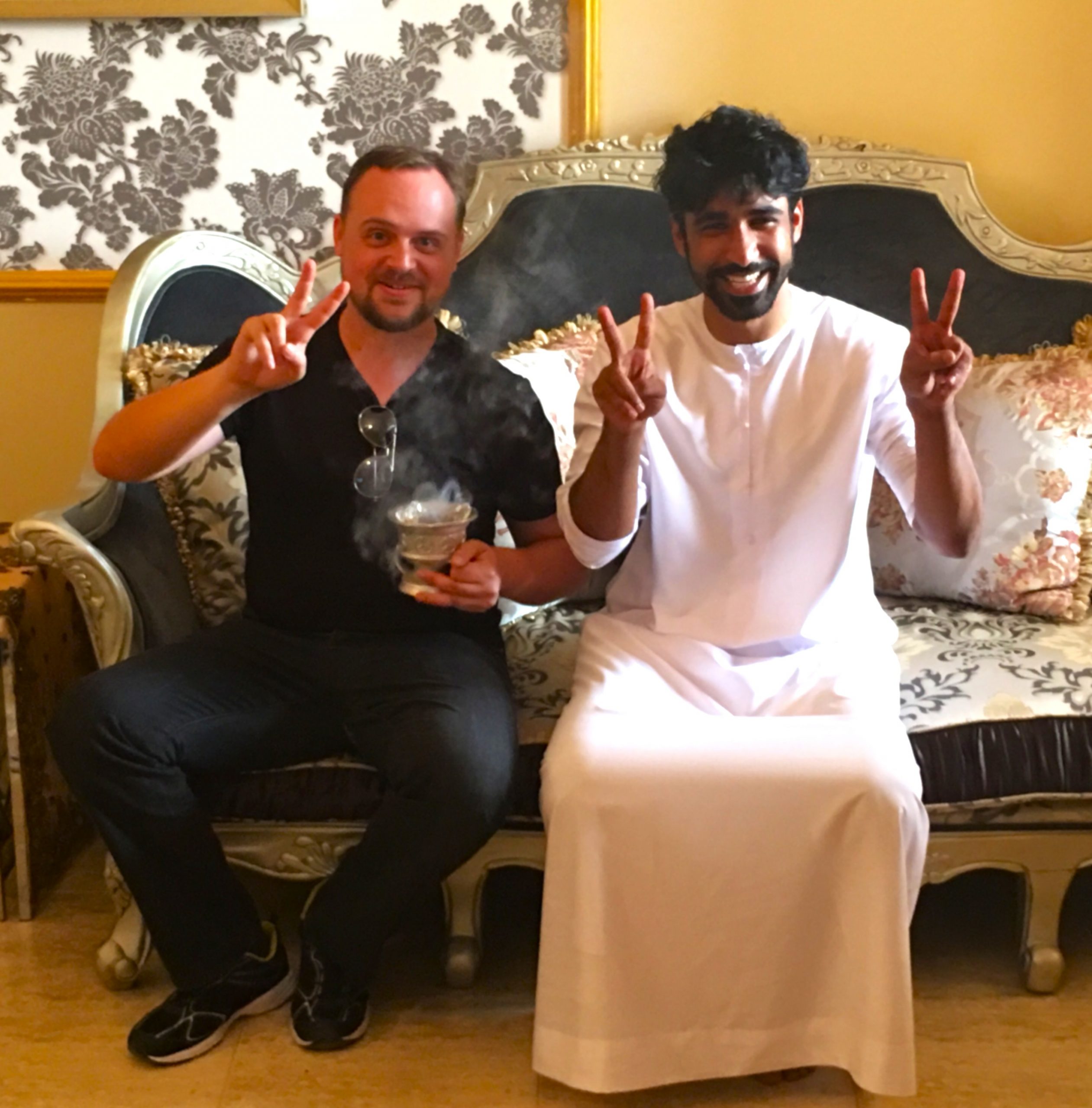
This stirred memories in me, recalling the story of when I took the attached photo – ten years ago now, when my son Mark and I were travelling from Australia to the UK and Germany. We stopped over in Dubai to visit Aisha and her family in Sharjah. Aisha was a student in my International Tourism class while teaching at Zayed University.
The energy in their home was welcoming, warm, unguarded, and full of joy and mutual appreciation. When I asked Mark and Sultan, Aisha’s husband, to look up for a photo, they spontaneously held up the peace sign. It wasn’t a pose or a performance; it was a moment of pure, uncalculated connection. In that split second, I realised:
Peace is a relational state of connection: a state of caring minds and thoughtful hearts.
Peace is a value close to our hearts. It is imperative for our sense of survival, our sense of wellbeing, and our sense of happiness.
It is interesting to note that, when it comes to happiness, there is growing interest in the pursuit of individual projects, including travel, that “promise” inner peace with a focus on self-care, mindfulness, and individual empowerment.
However, as already pointed out, peace is also about outer peace, about relational mindfulness and relational empowerment – concepts promoted by well-known couple and family therapist Terry Real.
A psychological perspective helps to understand what happiness means for each individual when travelling, while a social-psychological lens offers us a relational view. This approach raises our awareness of the complexities inherent in the concept of peace, none more so than in relation to travel and tourism.
Travel and tourism are treated by many as a ‘separate bubble’ in contrast to daily life. Yet, they are both a microcosm of society. They are a reflection of cultural and individual value systems at any given time and place, known to potentially clash, creating inner and outer conflict.
Conflict is the other side of the coin so to speak of peace, which is linked to not only different worldviews but also access to resources and power and control. To understand peace and conflict, we benefit from distinguishing two levels of power:
-
- The Lust for Power at an individual analysis level (the “me” that seeks control).
- The Struggle for Power at a systemic analysis level (the structures of inequality).
If we only look at the individual “lust for power,” we miss the systemic “struggle for power,” and Visa Versa.
Psychologist and therapist Esther Perel reminds us that
“In today’s world, intimate relationships are the new site of conflict.”
The “lust for power” in a relationship mirrors the “struggle for power” on a global stage.
The profound truth is: we cannot treat the individual and the system as separate silos. Conflict, just like peace, exists between humans at all levels, from the micro of our homes to the macro of our world.
A systems approach helps us understand the intimate relationship between inner and outer peace and inner and outer conflict while highlighting relevant actions.
-
- Micro Level: The pause between trigger and response; choosing trust over fear; understanding that fear is the engine for conflict while trust is the engine for peace.
- Meso Level: The “Relational Ecology.” Asking “What’s good for us?” instead of “What do I want?” and “How can I get it?”
- Macro Level: The structures we live in. Acknowledging that individual peace cannot flourish in a system grounded in individualism and a system built on “power over.”
Former UN Secretary General Kofi Annan pointed out that the process of globalisation has brought people together in many ways – and travel and tourism are seen to do just that. Yet, it has also driven people apart. It has done so by failing to share not only the benefits but also the burdens, perpetuating inequalities experienced by many.
It is important to remember that peace starts at home, in our immediate relationships and environments – in our intimate partnerships, in our families, among friends, at work, all with a potential to reverberate into society at large.
Peace also functions the other way around, when peace-oriented leaders on the global stage stand up for human dignity, mutual respect, and actions that create opportunities for peaceful coexistence.
Peace, at its core, is about relationships. And relationships are recognised to go through stages of harmony and disharmony, connection and reconnection. Peace in the end is about the willingness to repair that which might be broken.
Peace rests in the choices we make every day. It rests on our relational capacity to show that we dare to care and connect on our journey through life. We can take agency as relational champions and ambassadors for goodwill, appreciating that
Peace begins the moment control ends. And that place is not just within us; it is between us.